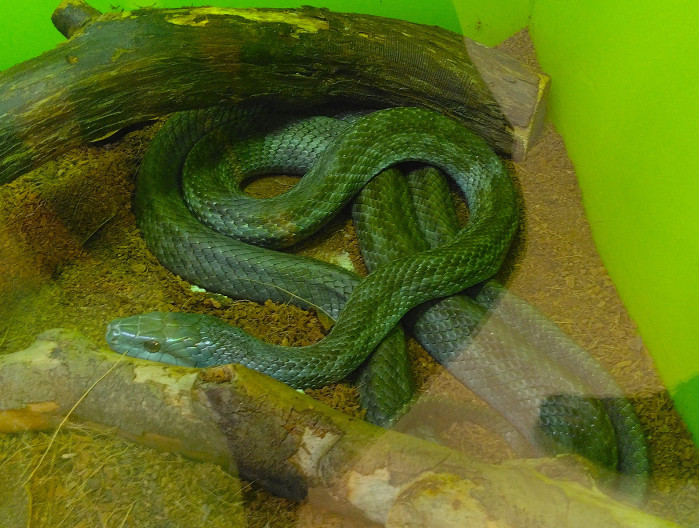
”アオダイショウ” ”Japanese rat snake”
暗いオリーブ色の体色からその名が付いている。毒はない。日本の温帯な気候が適しており、北海道から九州まで広範に生息している。体長は、長いと2.5メートルを超えるため、後方から襲来した敵に備えてトグロを巻いているとか。餌を求める時は樹上から地中まで探索する活動性があるものの、実は憶病であるところが残念である。Its name is derived from its dark olive-colored body. It is non-venomous. It is
暗いオリーブ色の体色からその名が付いている。毒はない。日本の温帯な気候が適しており、北海道から九州まで広範に生息している。体長は、長いと2.5メートルを超えるため、後方から襲来した敵に備えてトグロを巻いているとか。餌を求める時は樹上から地中まで探索する活動性があるものの、実は憶病であるところが残念である。Its name is derived from its dark olive-colored body. It is non-venomous. It is
well-suited to Japan's temperate climate and inhabits a wide range of areas,
from Hokkaido to Kyushu. Since its body length can exceed 2.5 meters, it
reportedly coils itself up to guard against enemies attacking from the rear.
Although it is active enough to search for food from trees to underground, it is
unfortunately quite timid.
腹の両端の鱗に角張った側稜があり、これを巧みに使って木を登る。主食がネズミなのも、都市部でよく見かける一因である。害獣の駆除に一役買っているため、益獣としている地域もある。
The scales on both ends of its abdomen have angular lateral ridges, which it skillfully uses to climb trees. The fact that its main diet consists of mice is one
reason why it is often seen in urban areas. In some regions, it is considered
beneficial animals because it plays a role in exterminating pest animals.
小学生の頃、林沿いの細道でよく脱皮後の皮を見付けた。金運がいいと親から教わり、財布に入れていた記憶がある。
When I was in elementary school, I often found its shed skins along narrow paths by the woods. I remember my parents telling me it brought good financial luck, so I used to keep them in my wallet.
”マンジュウイシモチ” "Pajama cardinalfish"
英和の名前の由来が面白い。和名は丸い容姿が饅頭に似ているから、英名は斑点がパジャマの模様に似ているからである。因みに、体の後方に赤い斑点があることから、ダイバーの間では”イチゴパンツ”の異名もある。どの名前も、残念である。余談ではあるが、お腹の黒い帯は”腹巻”に見えないか?突っ込見所満載である。The origins of its English and Japanese names are quite amusing. The
英和の名前の由来が面白い。和名は丸い容姿が饅頭に似ているから、英名は斑点がパジャマの模様に似ているからである。因みに、体の後方に赤い斑点があることから、ダイバーの間では”イチゴパンツ”の異名もある。どの名前も、残念である。余談ではあるが、お腹の黒い帯は”腹巻”に見えないか?突っ込見所満載である。The origins of its English and Japanese names are quite amusing. The
Japanese name comes from its round appearance, which resembles a *manju* (steamed bun), while the English name stems from spots that look like a
pajama pattern. Incidentally, because of the red spots on the rear of its body, it
is also nicknamed "Strawberry Pants" among divers. All of them are unfortunate names. As a side note, doesn't that black band around the belly look like a
"haramaki" (belly warmer)? It is packed with things to poke fun at.
日本では石垣島以南で観察でき、サンゴ礁に生息する。テンジクダイの仲間なので、やはり卵は雄が口の中で育てる。
In Japan, it can be observed from Ishigaki Island southward and inhabits coral reefs. As a member of the cardinalfish family, the male carries and incubates
the eggs in his mouth.
”ヒラリーカエルガメ” ”Hilare's toad-headed turtle”
ヘビクビガメ科カエルガメ属との、理解の難しいところに属している。要するに、カエルのような顔をしているが、首は蛇のように長いと言いたいのであろう。首が長すぎて一般の亀のようには頭が甲羅に治まらないので、折りたたむようにして甲羅内に引っ込めるのが残念である。
It belongs to a group within the family Chelidae (snake-necked turtles) that is
ヘビクビガメ科カエルガメ属との、理解の難しいところに属している。要するに、カエルのような顔をしているが、首は蛇のように長いと言いたいのであろう。首が長すぎて一般の亀のようには頭が甲羅に治まらないので、折りたたむようにして甲羅内に引っ込めるのが残念である。
It belongs to a group within the family Chelidae (snake-necked turtles) that is
somewhat difficult to classify. In short, the name implies that while it has a
frog-like face, it possesses a long, snake-like neck. Unfortunately, because its
neck is too long to fit into the shell in the manner of ordinary turtles, it must fold
the neck to retract it inside.
南米の湖沼に生息する。指の間に水掻きがあるので普段は水中で生活するが、産卵はウミガメのように陸で行う。
It inhabits lakes and marshes in South America. It has webbed feet, so it
南米の湖沼に生息する。指の間に水掻きがあるので普段は水中で生活するが、産卵はウミガメのように陸で行う。
normally lives in the water, but it lays its eggs on land, much like a sea turtle.
”ミーアキャット” ”Meerkat”
アフリカ南部の砂漠に生息し、毒を持つサソリやムカデなどを好んで捕食する。そのためか、毒には耐性があるため刺されても死ぬことはない。調子に乗ってコブラなどに襲い掛かることもあるようだが、さすがにそれは返り討ちにあってしまうのが、残念な所である。Inhabiting the deserts of southern Africa, it favors venomous prey such as
アフリカ南部の砂漠に生息し、毒を持つサソリやムカデなどを好んで捕食する。そのためか、毒には耐性があるため刺されても死ぬことはない。調子に乗ってコブラなどに襲い掛かることもあるようだが、さすがにそれは返り討ちにあってしまうのが、残念な所である。Inhabiting the deserts of southern Africa, it favors venomous prey such as
scorpions and centipedes. Perhaps as a result, it possesses a resistance to
venom and does not die even if stung. It sometimes is elated and lunges at
creatures like cobras, but unfortunately, it invariably ends up getting the worst of the encounter.
2,3家族で20~30頭の集団生活している。社会性が高く、見張りや子育てなどの役割を分担し、交代もする。頂点は雌、社会の中心も雌であり、子育ては雄が実践する女系社会である。巣穴を掘る際には皆が一列に並び、バケツリレー方式で砂を掻き出していくとか。ここにも、高い社会性を見て取れる。
It lives in groups of 20 to 30 individuals, consisting of two or three families. It possesses a high degree of social intelligence, sharing and rotating roles such as guarding and raising offspring. It is a matriarchal society where the female
stands at the pinnacle and serves as the social core, while the male carries out the child-rearing. When digging their burrows, they all line up in a row and use a bucket brigade system to scoop out the sand. Here too, we can see a high level of social skills.
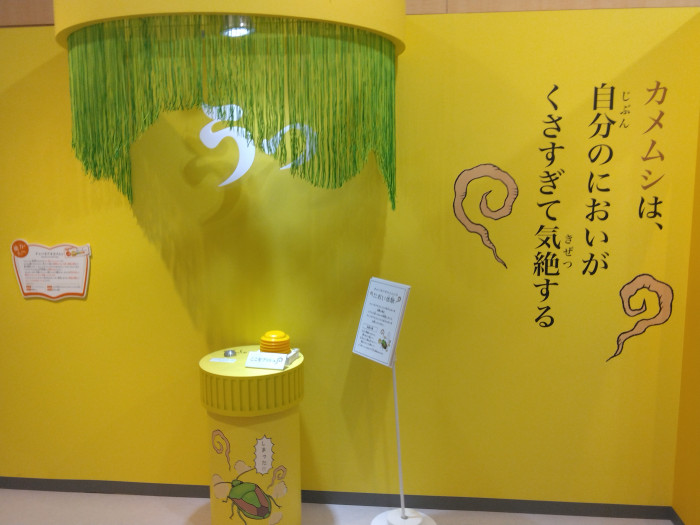
”チャバネアオカメムシ” ”Species of stink bug”
主にスギやヒノキの球果に寄生する。果樹によく寄生しているように思うが、果樹では生育できない。これは、人間が品種改良で果物を速く大きく成長させるため、遺伝的に野生の果樹が最適と刷り込まれているカメムシには分からないからとのこと。It mainly parasitizes the cones of Japanese cedar and cypress trees. It seems
主にスギやヒノキの球果に寄生する。果樹によく寄生しているように思うが、果樹では生育できない。これは、人間が品種改良で果物を速く大きく成長させるため、遺伝的に野生の果樹が最適と刷り込まれているカメムシには分からないからとのこと。It mainly parasitizes the cones of Japanese cedar and cypress trees. It seems
to often parasitize fruit trees, but it cannot grow on fruit trees. This is said to be because stink bugs—whose instincts are genetically hardwired to favor wild fruit trees—cannot comprehend the results of selective breeding, through which
humans have caused fruit to grow larger and faster.
足の付け根から、例の匂いを発する液体を放出する。これに毒性のあるアセトアルデヒドが含まれており、容器に閉じ込めてこの液体を放出させると、自ら気絶してしまうのが、残念な所である。
It releases its characteristic foul-smelling fluid from the base of its legs. This fluid contains toxic acetaldehyde; unfortunately, if the insect is confined in a
container and forced to release the fluid, it ends up knocking itself unconscious.
雄は集合フェロモンを放出し、仲間に餌の在処などを伝える。現在、この原理を利用した駆虫法を考案中とのことである。
Males release aggregation pheromones to signal the location of food sources to others of the kind. Pest control methods utilizing this mechanism are currently being developed.
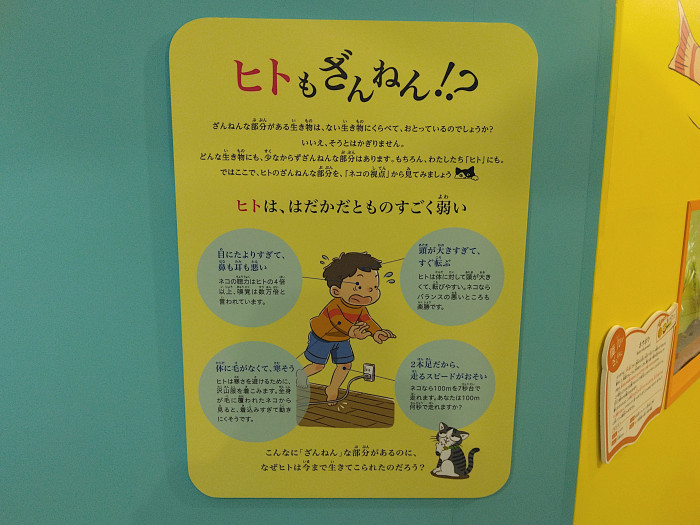
因みにではあるが、我々”人間”も(猫目線で)残念さを紹介されていた。Incidentally, we "humans" were also portrayed—from a cat's perspective—as
being rather pathetic.
まずは、目に依存し過ぎたため、嗅覚や聴力が弱い。脳が発達し頭が大きくなった分、頭が重たくて転びやすい。体毛をなくしたので、衣服で体温管理をしなければならない。2足歩行となったので、走るスピードが激減した。
For starters, because we rely too heavily on our eyes, our senses of smell and hearing are weak. Our brains developed and our heads grew larger, making them heavy and causing us to lose our balance easily. We lost our body hair, so we have to regulate our body temperature with clothing. And because we
became bipedal, our running speed dropped drastically.
一理あるが、う~ん、どうだろう。
There is some truth to that, but... hmm, I'm not so sure.